

Phosphate groups are one of the most popular modifications for our custom oligos. In this Know Your Oligo Mod blog post, we’ll explore how adding phosphates to either end of the oligonucleotide can dramatically alter its behaviour for molecular diagnostics applications.
5' phosphate for ligation
The main reason for adding a 5' phosphate moiety to oligos is to enable ligation reactions. DNA ligase enzymes join two DNA or RNA fragments by forming a phosphodiester bond between a 5' phosphate and a 3' hydroxyl.
Standard oligos ordered from suppliers typically lack a 5' phosphate, so this must be included in the design if you plan to use your oligos in a ligation reaction. A 5' phosphate in PCR primers will lead to the reaction products also carrying this modification, ready for ligation into vectors or longer constructs.
Ligation is also heavily used in NGS library prep and so phosphate groups must be considered when designing oligos. Adapters (such as P7 in Illumina sequencing by synthesis) need 5' phosphate groups for ligase to attach them to the 3'-OH of DNA fragments.
Ligation reactions can be used in highly sensitive assays for point mutations. For example, some assays use oligos known as padlock probes, where the two ends are brought into close contact when they hybridise with the target sequence.1 A ligase enzyme can then circularise the oligo by joining the ends together, as long as there’s a 5' phosphate group. The resulting circular oligo can then be detected using rolling circle amplification. For more details, see our blog post on how thermostable DNA ligase can help to detect rare point mutations.
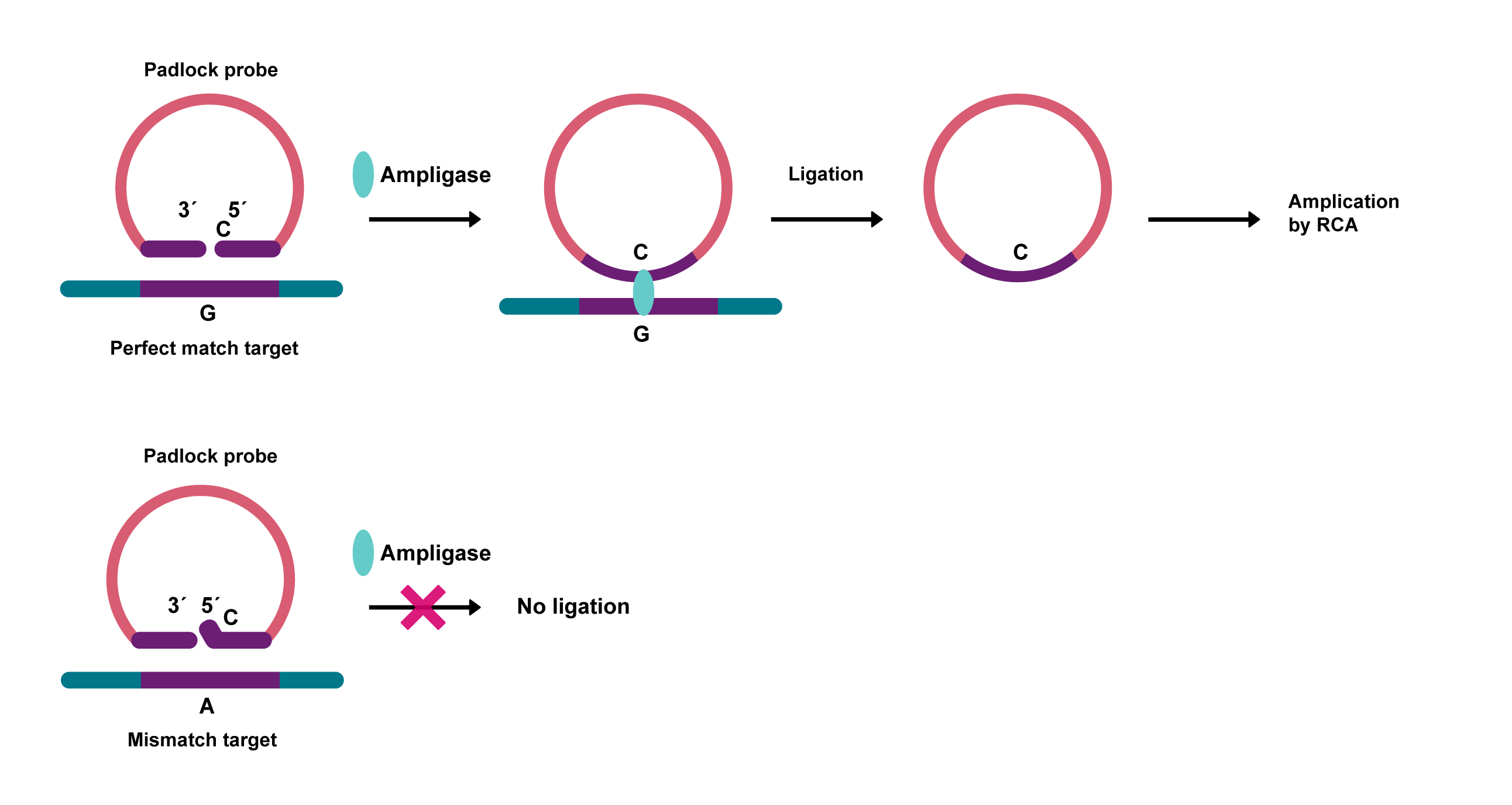
Figure 1. Padlock probe circularisation using Ampligase, which relies on a 5' phosphate for ligation.
Enzymes like T4 polynucleotide kinase (PNK) can phosphorylate the 5' terminus, but synthesising the oligos with a 5' phosphate avoids this additional step and the need to purify any non-phosphorylated oligos in the reaction product mix.
3' phosphate for blocking
A phosphate group at the 3' end blocks polymerase from extending that strand, as polymerases rely on a free 3'-OH group to attach a further nucleotide.
Many qPCR hydrolysis probes have a quencher dye at the 3' terminus, which prevents polymerase extension. However, if a probe has an internal quencher, 3' phosphate is a popular and straightforward choice to avoid the oligo acting as a primer when it hybridises to the target sequence.
3' phosphate has also been used to create ‘blocking primers’ in an innovative technique for enriching mutations by PCR. The technique, known as mutant enrichment with 3′-modified oligonucleotides (MEMO), uses a blocking primer that perfectly matches the wild-type sequence and overlaps with a generic primer that can amplify any allele.2
 An excess of the blocking primer in the reaction mix competes with the generic primer on wild-type alleles, while allowing low-abundance mutations to be amplified. This offers a simple method to enrich multiple mutations, even in degraded DNA samples.3 MEMO has been used to detect mutations for prenatal diagnosis of cystic fibrosis and identify rare cancer mutations missed by allele-specific PCR.4,5
3' phosphate also acts as a protective group against 3'→5' exonucleases, as these enzymes act via the terminal 3'-OH. This can be useful in workflows where unprotected DNA needs to be digested, so that just the desired strands with the 3' phosphate remain in the mix.
Alternatives to 3' phosphate include dideoxynucleotides (which lack the 3'-OH group), a C3 propyl spacer or any large group at the 3' terminus, like a dye or quencher. These are less likely than phosphate to be removed and will effectively prevent polymerase extension.6
Phosphate can have an advantage over other 3' groups if you need to remove the protective group later, which can be done easily with phosphatase enzymes.
Find the right modification for your needs
In summary, phosphate groups serve two popular purposes, depending on their position.
At the 5' terminus, phosphate is essential for ligation reactions, which can be important for many purposes, including ligating adapters for NGS library prep. Incorporating the phosphate group as a modification during oligo synthesis gives you a reliable and pure product without the extra effort required with enzymatic methods.
At the 3' terminus, phosphate groups are an effective solution for preventing extension by polymerases and digestion by some exonucleases. This is particularly useful for hydrolysis probes that don’t have a quencher at the 3' end. Other 3' modifications can be even more effective, but these may influence the oligo’s activity.
Explore our vast portfolio of modifications and discover the perfect solution for your next project.

Know Your Oligo Mod series
References
- Cao G et al. (2021) Single-nucleotide variant of PIK3CA H1047R gene assay by CRISPR/Cas12a combined with rolling circle amplification. Analytica Chimica Acta 1182:338943 doi: 10.1016/j.aca.2021.338943
- Lee ST et al. (2011) Mutant enrichment with 3′-modified oligonucleotides: a practical PCR method for detecting trace mutant DNAs. J Mol Diagn 13:657–68 doi: 10.1016/j.jmoldx.2011.07.003
- Darbeheshti F et al. (2022) Recent Developments in Mutation Enrichment and Detection Technologies. Clinical Chemistry 68(10):1250–1260, doi: 10.1093/clinchem/hvac093
- Guissart C et al. (2017) Non-invasive prenatal diagnosis (NIPD) of cystic fibrosis: an optimized protocol using MEMO fluorescent PCR to detect the p.Phe508del mutation. Journal of Cystic Fibrosis 16(2):198-206 doi: 10.1016/j.jcf.2016.12.011
- Jang MA et al. (2012) Identification of a Rare 3 bp BRAF Gene Deletion in a Thyroid Nodule by Mutant Enrichment with 3'-Modified Oligonucleotides Polymerase Chain Reaction. Annals of Laboratory Medicine 32(3):238-241 doi: 10.3343/alm.2012.32.3.238
- Cradic KW et al. (2004) Substitution of 3′-phosphate cap with a carbon-based blocker reduces the possibility of fluorescence resonance energy transfer probe failure in real-time PCR assays. Clinical Chemistry 50(6):1080-1082 doi: 10.1373/clinchem.2004.033183
