

Human activity is driving sharp reductions in the population sizes of many species worldwide. These anthropogenic bottlenecks erode genetic diversity and are contributing to what many scientists now describe as a mass extinction event.1
To understand the consequences of these declines, and to better guide biodiversity conservation, researchers are increasingly turning to population genomics – the large-scale study of genetic variation across entire genomes within and among populations.
In a recent study,2 researchers applied this approach to a critically endangered island harrier to test the historical impact of human activity on this species, quantify inbreeding and mutation load (the reduction in fitness due to harmful genetic mutations accumulated over generations) and evaluate the species' potential to adapt in the future. In this article, we’ll look at how they did this and what they found.
The conservation problem
The Réunion harrier (Circus maillardi) is an endangered island raptor, confined to the island of Réunion in the Indian Ocean. Since the arrival of humans on the island around 400 years ago, the Réunion harrier has experienced intense pressures such as rapid habitat destruction and the introduction of numerous invasive species. This impact has reduced the number of remaining breeding pairs to approximately 200, raising serious concerns about the long‑term genetic health and viability of the population.
Research objectives
The aims for this study were as follows:
- Test whether the Réunion harrier shows population structure within the island, for example due to geographical barriers, and estimate inbreeding among individuals.
- Examine how recently, and how severely, the population has declined and compare this demographic history to the timeline of human colonisation of Réunion.
- Test whether patterns of genetic variation support the idea that past bottlenecks have purged some deleterious mutations and investigate whether a substantial burden of harmful variants remains.
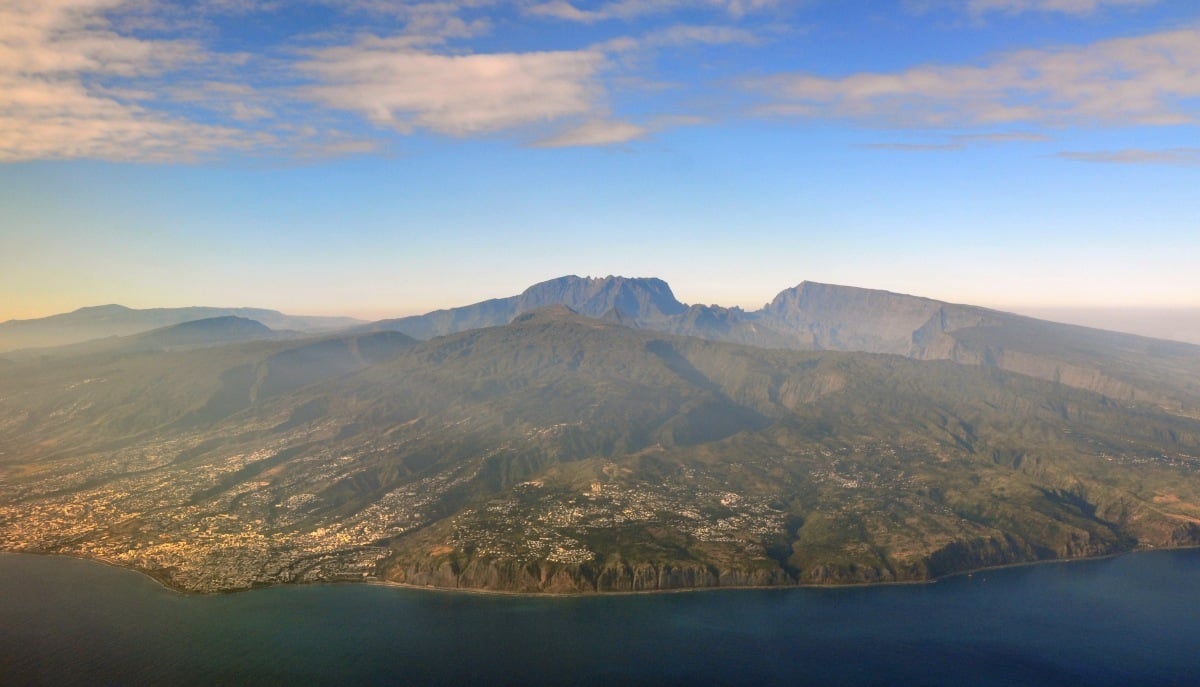
North side of the island of Réunion (Indian Ocean) as seen from the air.
Sample collection and library preparation
The team sampled a total of 61 harriers from the West and North‑East sides of the island, to cover the two regions that are separated by a volcanic range. Birds were caught using claptraps, pole traps, or whoosh nets, and marked with rings and wing tags.
To extract the DNA, blood samples from captured birds and claws collected from harriers found dead or critically injured were sent to LGC. There, the team used the magnetic beads DNA purification kits, sbeadex Tissue DNA Purification Kit and sbeadex Blood DNA Purification Kit, providing high-quality, inhibitor‑free DNA suitable for next generation sequencing (NGS) and other applications. They also prepared normalised genotyping by sequencing (GBS) libraries3 using the MslI restriction enzyme, and sequenced them on an Illumina NextSeq 550 platform. Sequencing reads were cleaned and quality checked before loci were assembled.
Reconstructing history using genomic data
With the resulting high-quality data, the researchers were able to study the variation in near-neutral loci – or ‘background’ regions of the genome, where mutations have little or no effect on fitness and are shaped by drift. These regions can be used to reconstruct past changes in population size and diversity.
Using a collection of R package tools, individuals were assigned to genetic clusters to characterise the population structure, barriers to gene flow were identified, inbreeding was estimated, and variation in effective population sizes over time was explored.
The population model revealed distinct populations on the western and north‑eastern parts of Réunion, either side of the volcanic range, with some long-distance dispersal events observed. A mapping of migration rates and diversity confirmed the barrier to gene flow between the East and the West of the island, and lower genetic diversity in North-Eastern individuals. Pairwise relatedness between samples demonstrated a high proportion of first or second-degree relatives in the dataset, indicative of inbreeding.
Demographic analysis showed a decline in population size starting more than 1000 years ago, with a steeper decline starting approximately 100 years ago, consistent with intense human impact on the island.
Studying coding genes to understand mutation load
The researchers also studied variation in coding loci – which are regions of DNA that code for protein, and therefore any mutations in these regions can induce potentially harmful or beneficial changes. These regions were used to assess mutation load and the harrier’s future adaptive prospects.
Using RNA sequencing, transcriptomes were obtained for five individuals. Resulting reads were aligned to a close relative species, the not currently endangered Circus melanoleucos, to obtain insights about the possible role of small population size on mutation load.
Comparing the frequency of mRNA variants expected to have a high effect (e.g. a premature stop codon) with those expected to have a lower effect suggested that high-effect variants have been purged. However, inbreeding and demographic bottlenecks do not appear to have prevented the accumulation of variants of moderate effect.
Future impact
This study reveals the substantial impact that human activity has had on the genetic diversity and adaptive potential of the Réunion harrier. The results can help refine conservation strategies, to consider high levels of inbreeding particularly in the North-Eastern cluster, for example by translocating individuals and/or eggs from the Western cluster to the North-Eastern cluster.
With many other island and endemic species experiencing anthropogenic bottlenecks, similar genomic workflows can be used to reveal a deeper understanding of population risks that census data cannot capture.
Learn more about how LGC can support your genomics projects with sbeadex high-quality DNA purification kits and NGS technologies and services.
Further reading
- Genotyping dung advances conservation of endangered forest elephants
-
“A game changer”: How sbeadex Lightning prevented a three-month backlog
References
- Ripple WJ, Wolf C, Newsome TM, et al. (2017). World Scientists’ Warning to Humanity: A Second Notice, BioScience, 67(12), 1026–1028, doi: 10.1093/biosci/bix125
- Bourgeois Y, Warren BH, Augiron S. (2024). The burden of anthropogenic changes and mutation load in a critically endangered harrier from the Reunion biodiversity hotspot, Circus maillardi. Molecular Ecology. 33(6),e17300. doi: 10.1111/mec.17300
- Arvidsson S, Fartmann B, Winkler S, & Zimmermann W. (2016). Efficient high-throughput SNP discovery and genotyping using normalised genotyping-by-sequencing (nGBS). LGC Limited.
