

Controlled pore glass (CPG) has been a workhorse of solid‑phase oligonucleotide synthesis for decades. Its rigid, highly porous structure provides sites to anchor the first nucleoside and allows reagents to diffuse through a network of pores, producing high‑quality DNA and RNA sequences.
However, modern demands from techniques like next‑generation sequencing (NGS) and screening for therapeutic oligos require innovations to deliver on a smaller scale. One such innovation is PolyFrits™, where the solid support is embedded in a porous polymer matrix, creating preformed frits that are highly efficient for sub-nanomole synthesis.
This blog post explores what PolyFrits are and how they support small-scale oligo synthesis and NGS.
How PolyFrits function in oligo synthesis
PolyFrits are composite frits where particles of CPG (or another solid support) are embedded within a porous plastic scaffold. This addresses the challenges of miniaturising oligo synthesis to nanomole or even picomole scales without losing uniformity or efficiency.
In traditional solid support oligo synthesis, the CPG is held in place by a frit at the bottom of the column. For high‑throughput applications, microplates with hundreds or thousands of tiny reaction wells are used, each requiring a miniaturised frit to retain the CPG beads.
Traditional packed-bed CPG was developed for oligo production at scales over 40 nmol. This can deliver superb quality, but uniform packing across hundreds to thousands of wells is hard to maintain and wastes time and reagents.1 This has left a gap in methods to efficiently synthesise high-quality, low volume oligos for higher-throughput approaches.
Instead of packing loose CPG beads into columns or wells, PolyFrits deliver high performance by combining the frit and the solid support into a uniform permeable plug. Because the CPG particles are embedded, there’s no need for a separate frit to retain them, simplifying the synthesis process.
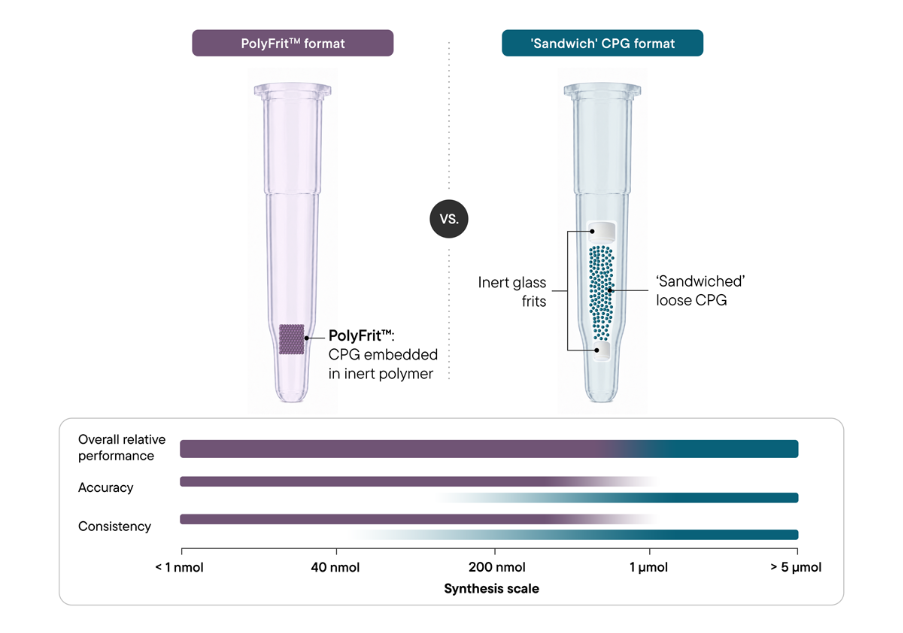
PolyFrits work with a bed volume as small as one cubic millimetre, allowing reagents to rapidly diffuse through the support and reducing the amount of reagent required. This is possible thanks to their high loading – up to 60% by volume.
With a uniformly distributed CPG, PolyFrits ensure that each well receives a consistent amount of starting material, improving reproducibility. The result is a compact, automation-friendly support designed for nanomole and sub-nanomole synthesis.
Applications in next‑generation sequencing
The advent of next‑generation sequencing (NGS) has shifted demand from synthesising a handful of custom primers to generating thousands or millions of oligos in parallel. NGS keeps pushing labs to make more primers and adapters, in more variants, at lower scales, without compromising fidelity.
To achieve cost-effective small-scale synthesis, fritted CPG provides a highly uniform distribution of the active ingredient in a tiny bed volume. This enables ultra‑low scale synthesis in plates, facilitating automated sample preparation for 96, 384 or even 1,536 samples.
PolyFrits ensure that each well has identical support mass and flow paths through the porous matrix. This reduces variability in coupling efficiency and yields, which is particularly important for NGS library prep, where uniform coverage across barcoded samples is critical.
Small-scale oligo synthesis is particularly useful for cancer minimal residual disease (MRD) detection. This is where NGS panels can identify even trace amounts of cancer remaining after treatment, allowing clinicians to respond quickly and effectively.
To detect these trace quantities, oligos are often used to enrich the sample with the target either by PCR amplification or biotin-tagged capture probes. For tumour-informed MRD, where the test is tailored to a particular genetic signature, these oligos need to be custom-made for an individual patient and so only picomole amounts need to be synthesised.
With traditional oligo synthesis approaches, this would mean that the vast majority of reagents would be wasted. However, with PolyFrits, hundreds of custom oligos can be produced in sub-nanomole quantities.
Small-scale synthesis for gene construction and therapeutic discovery
Gene synthesis is another use case where only small amounts of oligos are needed, as the genes can be propagated once assembled. Gene construction was the original purpose that drove the development of PolyFrits, which reduced reagent use by 90% compared to CPG columns. The quality of the oligos produced through solid-phase synthesis is very important here, as effective gene construction requires error rates of less than 1 in 1000.
Fritted CPG technology also supports screening designs of therapeutic oligos, including antisense gapmers, microRNA mimics and aptamers. After an initial high-throughput screening stage, high-quality small-scale synthesis is often required for winnowing candidate molecules through validation and preclinical studies.
PolyFrits can also benefit a wide range of discovery research, allowing scientists to create sub-nanomole batches of their desired oligos without wasting a fortune on unnecessary reagents.
How PolyFrits technology compares to other methods
Traditional CPG
Traditional CPG remains widely used for oligo synthesis, however, smaller scales can be much less efficient and create new difficulties. In micro‑well formats, packing CPG beads into dozens of wells is time‑consuming and can lead to uneven loading. Separate frits must be installed for each well to prevent CPG loss, adding complexity.
PolyFrits technology addresses these issues by embedding the support directly into a porous polymer frit. The key advantages over traditional CPG packed in columns or plates are:
- Uniform loading across wells: Each PolyFrit contains a measured amount of CPG with <10% variation.
- Low reagent consumption: The bed volume is as low as 1 mm³, reducing reagent use and waste, making it more sustainable at small scales.
- High loading capacity: Up to 60% of the frit volume is active support, offering comparable yield to traditional columns.
Polystyrene is an alternative solid support that has higher nucleoside loading than CPG and can be more cost-effective for large-scale synthesis thanks to its higher yield. PolyFrits can be created for custom supports, which we can advise on if required.
Microarrays
Microarrays are commonly used for producing massive libraries of oligos. This can be useful when the primary concern is producing tens of thousands of variations, covering the largest design space possible.
However, microarrays are more prone to errors than solid-support synthesis and by pooling the oligos it’s impractical to carry out quality control on individual sequences.1,2 This can lead to unequal quantities of oligos in the pool with some being under- or overrepresented.
PolyFrits, by contrast, allow thorough QC for single wells with a full range of base, sugar, backbone and label modifications available. This makes it suitable for follow-up validation studies after an initial screen using microarray synthesis, for example.
PolyFrits to drive your synthesis
Compared with traditional packed columns, PolyFrits technology simplifies assembly and improve consistency for small-scale synthesis.
By transforming CPG into a ready-made, uniform, automation-friendly frit, PolyFrits streamline NGS oligo production, lower per-variant costs at discovery scales and reduce common high-throughput pain points.
Biosearch Technologies™ offers PolyFrits loose in bulk or pre-loaded in a variety of formats, including columns, plates, pipette tips and custom styles. We can even customise the frits themselves with different geometries and functions. Get in touch to discuss options that suit your needs.
As the demands of genomics and therapeutics continue to grow, PolyFrits technology provides a powerful platform for cost-effective and high‑fidelity oligonucleotide synthesis on a sub-nanomole scale.

References
- Ma Y et al. (2024) Automated high-throughput DNA synthesis and assembly. Heliyon 10(6):e26967 https://www.cell.com/heliyon/fulltext/S2405-8440(24)02998-0
- Kuhn P et al. (2016) Next generation gene synthesis: From microarrays to genomes. Eng Life Sci. 17(1):6–13. doi: 10.1002/elsc.201600121
